
What the shift from browsing to seeking actually looks like for the person who needs support.
It's a Tuesday afternoon. Sam has been feeling flat for a couple of weeks now. Not in crisis, just worn down. Sleep has been patchy, work has been relentless, and today it caught up with her. She decides to do something about it and opens her workplace wellbeing platform.
What happens next depends entirely on what greets her when she does.
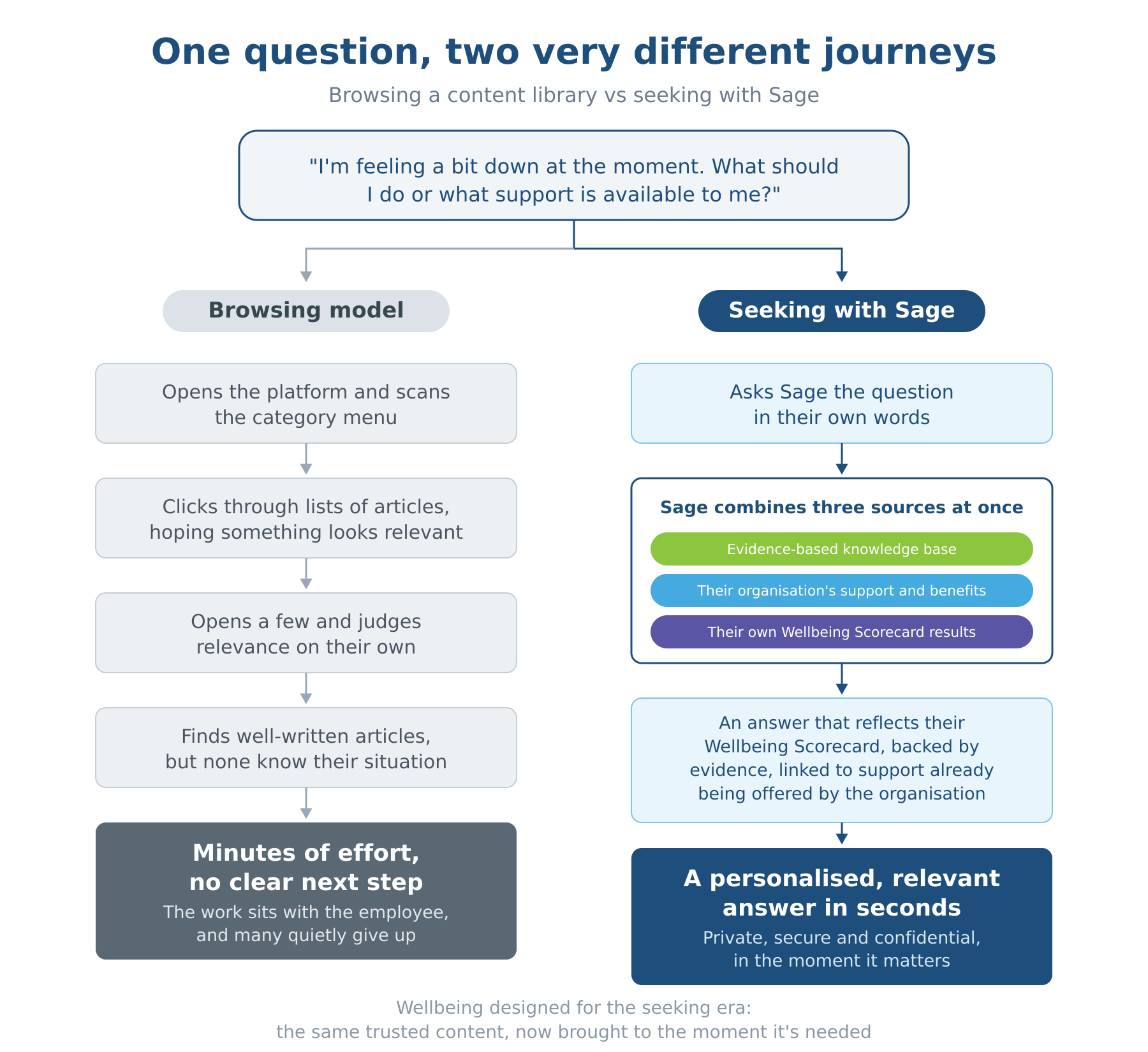
The browsing journey
On a traditional platform, Sam is greeted by a home page of tiles and categories. Mental Health. Sleep. Nutrition. Resilience. The content behind those tiles is good. Some of it is exactly what she needs. But Sam isn't sure which category describes what she's feeling, because what she's feeling doesn't fit neatly into one.
She tries the search bar: "feeling down". Back comes a list of well-written articles. Any one of them might genuinely help. But none of them can know that her sleep has been patchy, that her work-life balance is under strain, or that her employer funds confidential counselling sessions she could book this week. Working out which advice applies to her situation, and which support is actually available to her, is effort. And that effort is landing on Sam at precisely the moment she has the least energy for it.
After a few minutes, she closes the tab. The right article was in there somewhere. The right support existed too. Sam just never found her way to them. In our experience, most people in Sam's position don't persist. They give up quietly, and no engagement report ever shows what was almost found.
The library did its job. What Sam needed was a guide to walk her through it.
The seeking journey
Now run the same Tuesday again. Same platform, same trusted content, but this time with Synergy Health's Sage at the front door, an AI Assistant built for exactly this moment.
Instead of scanning categories, Sam types the question the way she'd ask a person: "I'm feeling a bit down at the moment. What should I do or what support is available to me?"
Sage doesn't reach for a generic article. It draws on three sources at once:
🟣 Her own Wellbeing Scorecard results. Sage can acknowledge what Sam is actually experiencing, like the sleep and work-life balance pressures showing in her latest assessment, so the response starts from her reality, not a template.
🟢 Evidence-based wellbeing guidance. The practical suggestions Sam receives are grounded in the same curated, peer-reviewed knowledge base she would have been browsing, now brought directly to her.
🔵 Her organisation's own support. Sage points Sam to the specific help her employer already provides, such as her Employee Assistance Programme, how many sessions she can access, and how to book one.
Within seconds, Sam has a response that recognises her situation, offers evidence-based steps she can take today, and connects her to the human support around her like her EAP provider.
Sam didn't need to know which category her feelings belonged to. She just needed to ask.
Why this difference matters
-
The effort moves to the platform. Browsing asks the person seeking help to do the searching, filtering, and interpreting. Seeking hands that work to the technology. That inversion matters most for the people who need support most, because energy and motivation are often exactly what they're short of.
-
Relevance is the difference between reading and acting. Even excellent content gets skimmed when it arrives without context. An answer that reflects your own results, your own workplace, and your own situation gets acted on.
-
Support arrives in the moment of need. Wellbeing needs don't schedule themselves around newsletter sends or awareness weeks. A seeking model means the platform is most useful at the exact moment someone reaches for it.
-
Existing investment finally gets used. Most organisations already fund good support: EAPs, benefits, policies, programmes. The barrier has rarely been the support itself. It's been the distance between the person and the support. Sage closes that distance.
-
Technology that leads to people, not away from them. Sage isn't there to replace human care. Its job is to remove every barrier between someone who needs help and the help that already exists, whether that's a practical evidence-based step, a workplace programme, or a conversation with a professional.
Wellbeing designed for the seeking era
For years, digital wellbeing meant building a better library, and that work still matters. Every answer Sage gives draws on the same trusted, evidence-based content. What's changed is what people expect at the front door. They're no longer browsing; they're seeking. They expect a response that speaks to their situation, with the library working quietly behind it.
The organisations that adapt to this shift won't just see better engagement numbers. They'll see more Sams finding their way to support on the Tuesday afternoon it matters, instead of closing the tab.
If you're curious what that shift could look like in your organisation, we'd love to compare notes.
Comments